Overview
Urban centers in India, including both bustling metros and sprawling megacities, have witnessed a distressing decline of 50% in their green foliage.
Open spaces are reducing year by year and cities are slowly converting to concrete jungles. Mega and metropolitan cities need a solution where many dense patches of forests can be created. The Miyawaki method is the way forward to bring a huge yet a quick and sustainable change in a small area by working towards restoration of resource depleted biodiversity.
The Miyawaki Method was invented by Japanese botanist and expert in plant ecology, Dr Akira Miyawaki. This Method is a unique innovative natural vegetation concept, proven to work worldwide, irrespective of soil and climatic conditions. More than 3,000 forests have been successfully created worldwide using this methodology.
In this method, 3-5 saplings are planted per square meter with a minimum of 20-50 different species, creating a multi-layered green forest with no maintenance required after a 2-3 year period.
Miyawaki plantation technique is the most suitable self-sustainable afforestation method. Forests grown using Miyawaki technique:
Have 10 times faster growth
30 times denser than traditional plantations
Requires less space
30 times better carbon dioxide absorption
100% organic
The Global Carbon Budget 2022 report states that if the emissions stay at the levels they are in 2022, it will take just 9 additional years for atmospheric CO2 to reach catastrophic levels leading to 1.5°C global warming. Emerging economies such as India account for 67% of carbon-dioxide emissions from energy in the past year.
There is a huge potential of switching to solar based electricity for community based organizations and nonprofits. Renewable Capacity Statistics 2023, by the International Renewable Energy Agency (IRENA) shows that 83% of all power capacity added last year was produced by renewables. There is an untapped potential to shift to a cleaner approach. However due to capital cost, many are at a disadvantage especially remote locations in rural India. Conventional electricity is a far-fetched dream in many villages in India even today. Due agricultural focus, ongoing needs of the community, and adoption to solar based electricity will help mitigate access to electricity and its potential emissions thereby providing a two pronged approach to improving lives by creating sustainable source of electricity and creating a ripple effect by improving health, education and livelihood opportunities.
Treating sewage before it enters a waterbody has thus become a necessity – if we want a clean and healthy environment. While a permanent solution to this would be to curb pollution at the source, there are intermediary measures that can be taken to restore a waterbody to its wholesome original self, conserve and enhance its biological diversity, preserve its ecosystem, and manage it while meeting current and future demand – without compromising on its ecological health and character.
The growing scale and urgency of the problem prompted us to enter the waterbody rejuvenation space
The Need
Our forest cover is being reduced at an alarming rate. Century-old trees are being brought down in a few hours and this loss is irreversible. However, there is a solution to bring back the lost green cover quickly. This project will supplement Government of India’s effort in increasing the country\’s forest cover to 33.33% thereby contributing to India’s commitments towards reduction of total projected carbon emissions by 1 billion tonnes (BT) by 2030 and to go carbon neutral by 2050, as per commitment made at COP27.
The Benefits
AThe program will sequester carbon, stabilize soil, filter water & air, regulate water flow and perform other ecological services. Planted trees will provide shade to cool microclimates, absorb some air pollutants, beautify green spaces, provide nesting and habitat for birds and other small animals, help to regulate stormwater, and contribute to human well-being..
The Intervention
Thrive India collaborates with ground experts in the field ranging from sapling selection, soil testing, and organic gardening and the selection of the suitable variety of saplings to be planted. UW India has planted saplings and will regularly tend to them for the next two years with an aim to promote self-sustenance of the forest and continue to grow the ecosystem.
Miyawaki forests grow 10 times faster, they are 100 times more biodiverse, 30 times better for noise and dust reduction and have 30 times more green surface area and are 100% organic, have up to 30 times better carbon dioxide absorption as compared to a monoculture plantation. So we get a 100 year old forest in just 10 years.
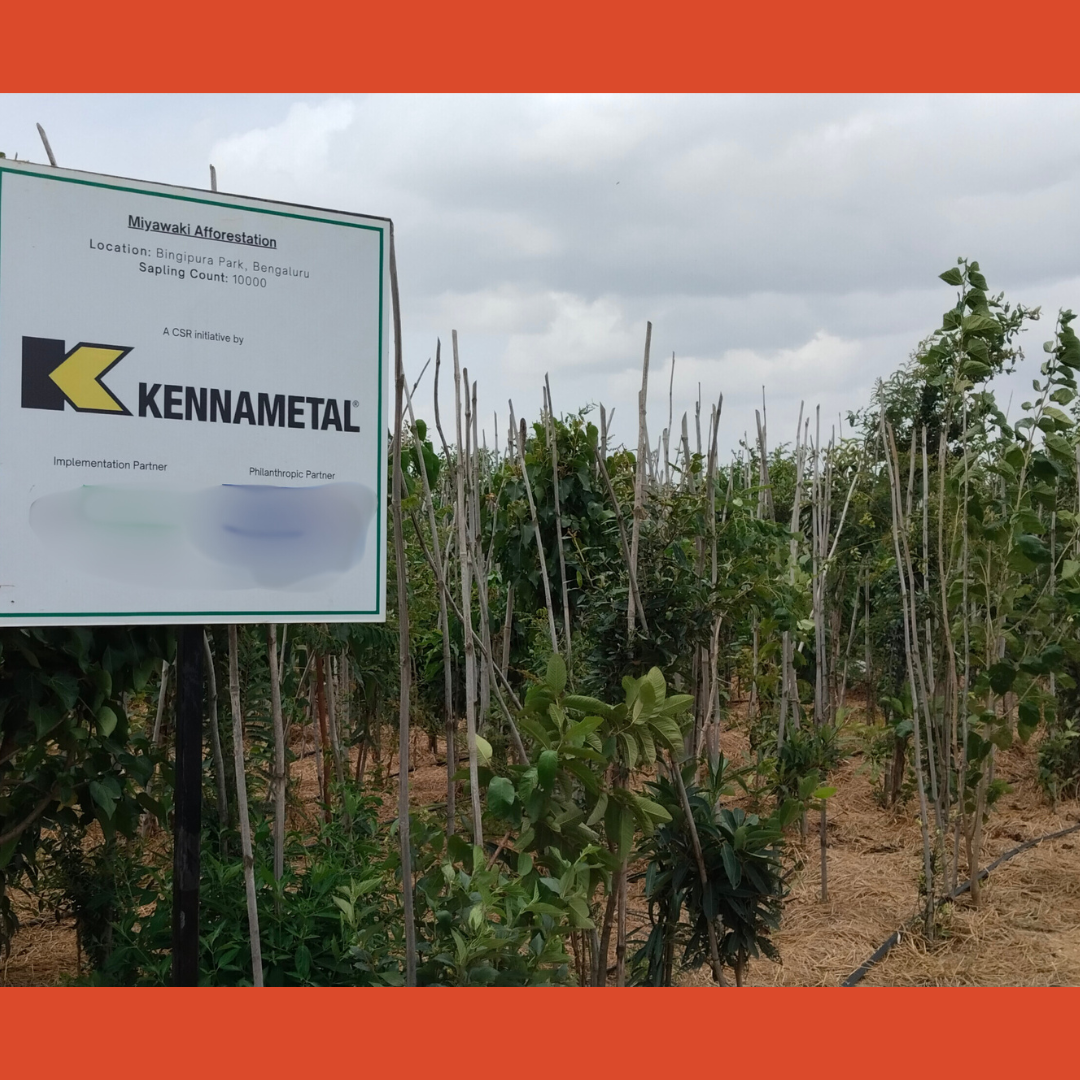
Thrive India has worked on several plantation projects in Bangalore, Delhi NCR and Pune using the Miyawaki technique.
Beneficiaries
Communities residing near Bingipura landfill, Bengaluru, ITI College Pirangut, Pune and NDRF, Ghaziabad, Delhi NCR
Impact Till Date
1More than 22,000+ saplings have been planted of 50+ species along with maintenance over a period of 2 years.
The plantation has contributed generously in altering deforestation and effects of climate change.
To know more, write to us at info@thriveindia.org